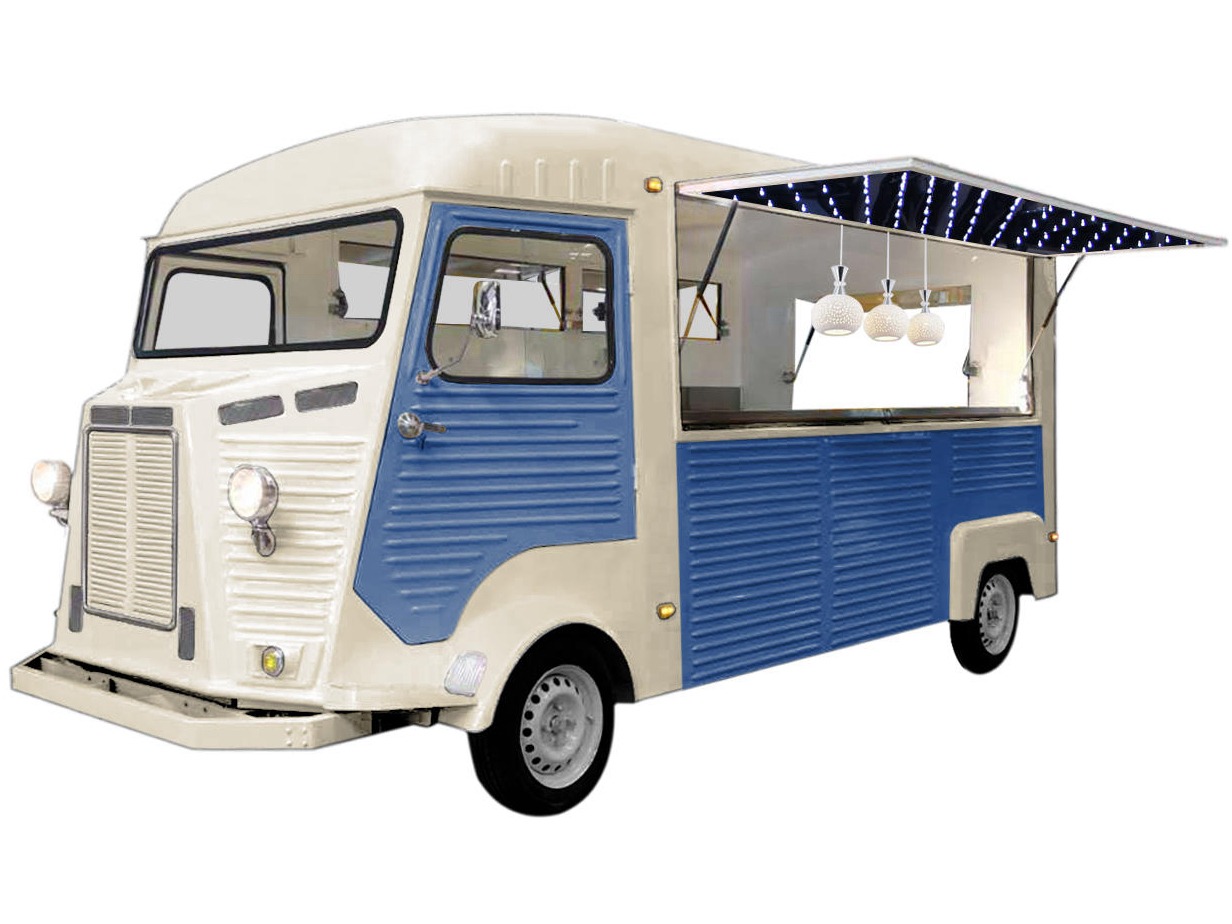
The Vintage Citroën HY food trailer is one of the most iconic retro mobile catering designs in Europe.
Its appearance attracts attention instantly.
But if you are planning to operate in the UK, design is only the beginning.
Building a Citroën HY food trailer for commercial use in the UK requires structural planning, safety awareness, and operational workflow thinking.
Here are the key factors serious buyers should evaluate before production begins.
1. Size Matters More Than Most Buyers Expect
Many first-time buyers consider 3.5m trailers because they appear manageable and cost-effective.
However, once you add:
- A commercial griddle
- A double fryer
- Refrigeration units
- Gas cylinder separation
- Proper prep space
You quickly realise space becomes operationally critical.
For UK street food events and high-volume service environments, a 5.8m Citroën HY configuration offers:
- Clear zoning between cooking and prep
- Space for multi-staff workflow
- Safer gas cabinet positioning
- Higher peak-hour serving capacity
Choosing size based on business model — not just budget — is essential.
2. Gas Cabinet Structure and Ventilation
UK operation places strong emphasis on safe gas positioning.
A properly structured Citroën HY trailer for the UK should consider:
- External gas cylinder cabinet
- Rain-protected ventilation openings
- Internal sealing to prevent airflow conflicts
- Sufficient space for compliant cylinder dimensions
In one recent 5.8m UK grill project, we restructured the gas cabinet by removing the internal door and sealing it with stainless steel plating, while adding controlled ventilation to the external panel.
Small structural decisions like this significantly reduce long-term operational risk.
3. Electrical Configuration Must Match Local Use
Not all “export-ready” trailers are truly adapted for UK commercial use.
A UK-aligned Citroën HY food trailer should include:
- 220V distribution board
- UK-standard sockets
- Proper circuit breakers
- External power inlet system
- Integrated refrigeration wiring
Incorrect socket standards or incomplete wiring setups often result in costly on-site modifications after arrival.
Planning electrical compatibility during production avoids these problems.
4. Single Axle vs Dual Axle for UK Roads
For smaller lightweight setups, single axle may be sufficient.
However, for a fully equipped 5.8m grill unit with hot kitchen equipment, dual axle configuration offers:
- Better weight distribution
- Improved towing stability
- Increased operational safety
This is particularly important for long-distance transport between events across the UK.
5. Workflow Design for High-Volume Service
The visual appeal of a Vintage Citroën HY trailer often overshadows workflow planning.
But real-world performance depends on:
- Logical equipment placement
- Separation of cooking and prep
- Adequate refrigeration positioning
- Water system access
- Staff movement efficiency
In commercial event environments, poor layout design quickly becomes operational stress.
A well-zoned 5.8m layout allows multiple staff to work simultaneously without congestion.
6. Export Structuring and Specification Confirmation
One of the most overlooked areas is pre-production specification control.
For UK-bound trailers, structured confirmation of:
- Gas cabinet dimensions
- Electrical standards
- Lighting systems
- Axle configuration
- Floor anti-slip treatment
should be completed before production begins.
Retro aesthetics may draw attention.
Structured engineering ensures longevity.
7. Final Thoughts
If you are evaluating a Vintage Citroën HY food trailer for the UK market, the real decision is not about style.
It is about structure.
The UK market demands safe gas configuration, compatible electrical systems, stable towing structure, and efficient commercial workflow.
Planning these elements early prevents costly modifications later.
If you’re considering developing a Citroën HY trailer for grill, coffee, or hospitality projects in the UK, specification planning should begin before production starts.