Introduction
One of the biggest strengths of Chinese food trailer manufacturing is flexibility.
Customers can often customize nearly every part of a trailer:
- body style
- trailer length
- serving windows
- doors
- kitchen layout
- electrical system
- plumbing
- cooking equipment
- exterior finishes
- branding
This level of flexibility is one reason Chinese manufacturers have become increasingly attractive to international buyers.
But customization is only one part of the story.
When we compare Chinese food trailer manufacturing with more mature trailer markets such as North America, the UK, Europe, Australia, and New Zealand, another difference becomes clear.
The real gap is not necessarily whether manufacturers understand basic trailer design principles.
The deeper difference is whether that knowledge has been turned into a systematic engineering process.
In other words:
The next stage of food trailer manufacturing is not simply more customization.
It is:
Customization + Engineering + Standardization + Repeatability
Why Chinese Food Trailer Manufacturers Can Offer Such High Customization
Many Chinese food trailer manufacturers operate under a highly vertically integrated production model.
A single factory may handle most of the production process internally:
Chassis fabrication
→ Body structure
→ Exterior panels
→ Doors and serving windows
→ Electrical installation
→ Plumbing
→ Stainless-steel kitchen
→ Equipment installation
→ Painting
→ Branding
→ Final assembly
This creates a major advantage.
The customer does not always need to start with an existing trailer platform.
Instead, the project can begin with the business concept.
For example:
“I need a 5-meter trailer.”
“I want two large serving windows.”
“I need a griddle, fryer, refrigerator, and preparation area.”
“I want a vintage-style exterior.”
“The entrance should be at the rear.”
“The kitchen equipment is heavy, so the axle position may need to change.”
Because many production processes are controlled by the same factory, these elements can often be designed together.
The manufacturing logic becomes:
Business concept
→ Interior layout
→ Body design
→ Chassis
→ Utilities
→ Equipment
→ Finished trailer
This is one reason Chinese factories can respond quickly to highly specific customer requirements.
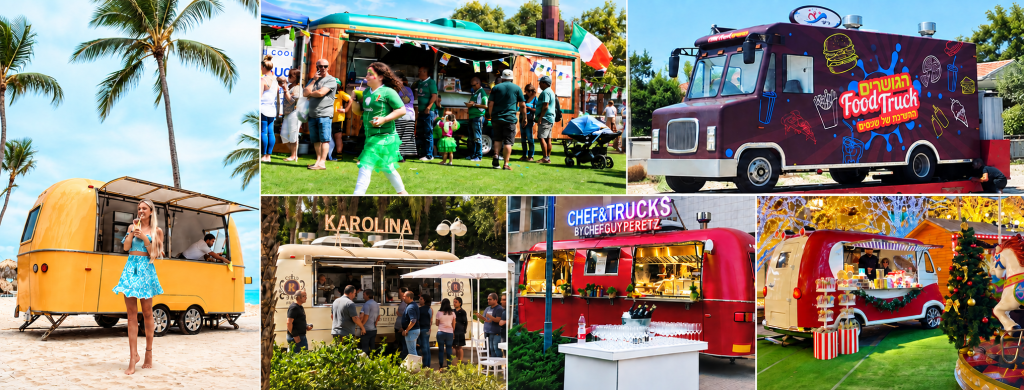
This flexibility can be seen in projects such as custom vintage food trailers, where dimensions, body style, kitchen layout and equipment can all be adapted to the project.
How Mature Trailer Markets Often Work Differently
In North America and Europe, the wider trailer industry is generally more specialized.
There may be separate companies responsible for:
- chassis and frame manufacturing
- axles and suspension
- braking systems
- trailer shells
- commercial conversions
- kitchen installations
- electrical systems
- ventilation systems
- graphics and branding
Many trailer manufacturers also work around established product platforms.
For example, a customer may first choose:
- 16 ft, 18 ft, or 20 ft
- single or tandem axle
- standard chassis specification
- fixed body width
- established suspension and braking components
Then the commercial layout is customized within that platform.
This creates a different production philosophy.
In many mature trailer markets:
The platform comes first.
Customization comes second.
This approach can reduce flexibility, but it creates other advantages:
- predictable weight distribution
- known axle positioning
- proven structural behavior
- standardized components
- easier regulatory approval
- simpler maintenance
- stronger production repeatability
This is why the difference should not be described as:
China is more advanced at customization, while Western manufacturers are less flexible.
A better description is:
Chinese manufacturers are often more project-based, while mature trailer markets are often more platform-based.
Both approaches have strengths.
Experience-Based Fabrication vs. Engineering-Based Manufacturing
Many experienced trailer factories in China already understand the basic principles of good trailer construction.
Experienced workers know that:
- heavy equipment should not all be placed at the rear
- axle position affects towing behavior
- large serving windows require reinforcement
- electrical cables should avoid heat and moving parts
- pumps and electrical panels require access
This knowledge is real and valuable.
But in many factories, it still exists mainly as:
experience, intuition, and workshop knowledge
rather than:
calculation, design rules, validation, testing, and documentation
This is an important distinction.
A worker may know from experience that an axle should be installed in a certain position.
An engineering-driven manufacturer should be able to explain:
- why that position was selected
- what the expected center of gravity is
- what the axle load will be
- what the tongue weight will be
- how those values change under different loading conditions
The difference is not simply knowledge.
The difference is systemization.
Six Areas Where Engineering Maturity Matters
1. Axle Placement
Axle placement is one of the most important parts of trailer design.
It should not be determined only by trailer length.
A properly designed axle position should consider the complete weight distribution of the finished trailer.
Major loads may include:
- cooking equipment
- refrigeration
- water tanks
- batteries
- generators
- gas cylinders
- HVAC
- stainless-steel cabinetry
- inventory and supplies
Food trailers are particularly complex because their weight distribution changes during operation.
For example:
At the beginning of the day, the fresh-water tank may be full.
At the end of the day, the fresh-water tank may be empty while the waste-water tank is full.
This can shift the trailer’s center of gravity.
A more mature design process therefore evaluates multiple loading conditions rather than only the empty trailer.
2. Tongue Weight
Tongue weight has a major influence on towing stability.
A trailer can look perfectly balanced when parked but behave very differently at highway speed.
Too little tongue weight may reduce towing stability.
Too much tongue weight may overload the towing vehicle, hitch, or coupler.
A professional design process should calculate and verify tongue load rather than simply judge whether the trailer feels front-heavy or rear-heavy.
A basic engineering model considers:
Component weight × component position
This makes it possible to calculate:
- total trailer mass
- center of gravity
- axle load
- tongue load
Ideally, these values should be checked under different operating conditions.
3. Structural Load
A trailer that is “strong” is not necessarily properly engineered.
Trailers experience continuous dynamic forces on the road:
- bending
- torsion
- vibration
- impact
- fatigue
Food trailers add further complexity.
Large serving windows remove structural material from the sidewall.
Heavy kitchen appliances may create concentrated floor loads.
Roof-mounted air conditioners create localized roof loads.
Axle mounting areas repeatedly transfer road forces into the chassis.
A mature structural design therefore considers not only material thickness, but also:
- load paths
- stress concentration
- reinforcement
- fatigue
- dynamic road loads
- frame stiffness
- local deformation
The goal should not simply be:
“Use more steel.”
The better question is:
“How does the load move through the entire structure?”
4. Wiring Routing
Electrical design is another area where engineering maturity becomes visible.
There is a difference between:
an electrical system that works
and:
an electrical system designed for long-term reliability
A mature wiring system should consider:
- cable routing
- vibration
- heat
- abrasion
- moisture
- moving components
- bend radius
- circuit protection
- labeling
- inspection access
- future troubleshooting
A wiring diagram shows how components are electrically connected.
A wiring harness layout shows where cables physically run through the trailer.
Both are important.
This becomes especially relevant after several years of operation, when technicians need to diagnose or replace components.
5. Service Access
Serviceability is one of the most underestimated elements of custom trailer design.
During production, factories naturally ask:
“How do we install this component?”
But mature product engineering also asks:
“How will somebody remove or replace it later?”
For example:
A water pump may be easy to install before cabinetry is completed.
But if the pump fails three years later, can it be replaced without removing the entire cabinet?
The same question applies to:
- refrigeration systems
- water tanks
- electrical panels
- plumbing connections
- ventilation systems
- pumps
- batteries
Good serviceability reduces downtime, labor cost, and long-term ownership cost.
For exported trailers, this is especially important because the original factory may be thousands of kilometers away.
6. Component Standardization
Component selection should not be based only on cost and immediate availability.
For exported trailers, another question becomes important:
Can the customer replace this component locally several years later?
This applies to:
- axles
- bearings
- brakes
- seals
- couplers
- lights
- switches
- breakers
- pumps
- suspension components
A component may be easy to purchase in China but difficult to replace in the United States, Canada, Europe, or Australia.
For export manufacturing, component selection should therefore consider:
- specification stability
- supplier continuity
- local availability
- interchangeability
- certification
- replacement alternatives
This is one reason mature trailer ecosystems often rely heavily on standardized component families.
The Real Transition: From Factory Experience to Company Capability
One of the most important challenges for growing manufacturers is converting individual experience into organizational knowledge.
For example:
“Our experienced worker knows where to position the axle.”
should gradually become:
a documented axle-placement method
“We always reinforce large serving windows this way.”
should become:
a structural design standard
“Our electrician knows where to route the wiring.”
should become:
a documented harness-routing specification
“We usually use this component.”
should become:
an approved component library with specifications and replacement options
This transition matters because experience that exists only inside one worker’s head is difficult to scale.
When that worker leaves, part of the company’s capability leaves with them.
But when the knowledge becomes:
Design Rule
→ Calculation
→ Drawing
→ Verification
→ Testing
→ Documentation
it becomes company capability.
That is the difference between skilled fabrication and an engineering system.
From Custom Projects to Repeatable Products
Customization is extremely valuable for individual food trailer buyers.
But dealers, restaurant chains, franchise groups, and fleet operators often have a different requirement.
They may not ask:
“Can you build 50 different trailers?”
They are more likely to ask:
“Can you build the same trailer 50 times?”
The first prototype may require extensive customization.
But once the design is validated, the next challenge is turning it into a repeatable platform.
That requires:
**Customization
- Engineering
- Standardization
- Quality control
- Repeatability**
This is where project-based manufacturing starts to evolve into industrial manufacturing.
Four Stages of Food Trailer Manufacturing Maturity
One useful way to understand the evolution of the industry is through four stages.
Stage 1: Can We Build It?
The focus is fabrication capability.
Can the factory weld the chassis?
Can it build the body?
Can it install the kitchen?
Stage 2: Can We Customize It?
The focus shifts to manufacturing flexibility.
Can the factory change the body shape?
Move the windows?
Change the kitchen layout?
Adapt to different equipment?
Many Chinese food trailer manufacturers are already very strong at this stage.
Stage 3: Can We Engineer It?
Now the questions become more technical.
Can the manufacturer calculate weight distribution?
Can it explain axle placement?
Can it validate structural design?
Can it document electrical systems?
Can it plan for maintenance and replacement parts?
Stage 4: Can We Reproduce It Consistently?
This is the industrialization stage.
A validated design becomes a repeatable product platform.
The goal is not only to build one good trailer.
The goal is to build:
10,
20,
50,
or 100
trailers with consistent quality.
What International Buyers Should Ask
When evaluating a food trailer manufacturer, buyers should not only ask:
“What can you customize?”
They should also ask:
- How is the axle position determined?
- Is tongue weight calculated?
- How is structural reinforcement designed?
- Is there an electrical schematic?
- Is wiring routing documented?
- Can major components be serviced easily?
- Are replacement parts available locally?
- Is the design suitable for repeat production?
- How is quality controlled between units?
These questions reveal much more about manufacturing capability than a finished product photo.
The Future of Food Trailer Manufacturing
China’s advantage in food trailer manufacturing is no longer simply lower cost.
Its real strength increasingly comes from:
vertical integration, fast manufacturing, and flexible customization
These are powerful advantages.
But the next competitive edge will come from combining that flexibility with stronger engineering systems.
The future manufacturer will not simply say:
“We can customize anything.”
It will be able to say:
“We can customize it, engineer it, validate it, document it, and reproduce it.”
That is a much more difficult capability to build.
But it is also a much more sustainable competitive advantage.
And for international buyers, dealers, and fleet operators, that difference will become increasingly important.